When the Safety Bicycle Changed the Shape of a Ride
The safety bicycle’s lower seat and rear-wheel chain drive changed how riders approached mounting, steering and everyday cycling, without erasing every barrier.
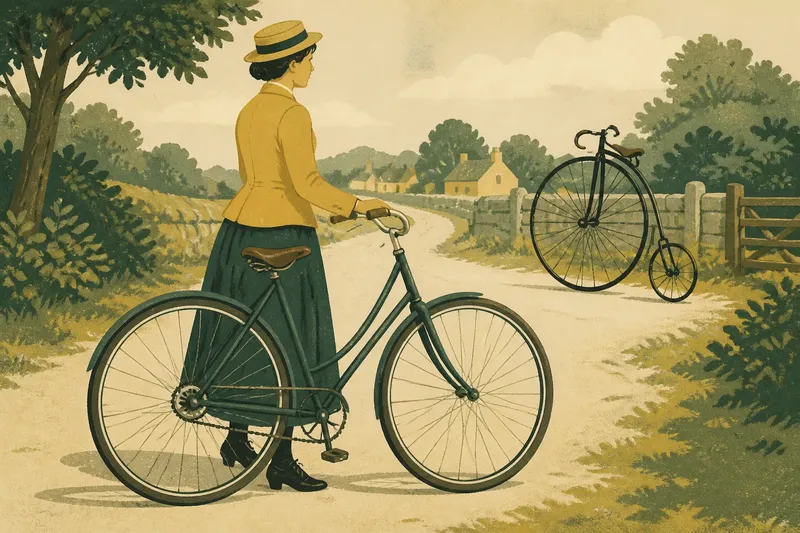
The common mistake is to treat the safety bicycle as a neater version of the high-wheel machine. Its design changed the rider’s position and the way power reached the road, making mounting and stopping less daunting for some people, though not effortless or equally accessible to all.
The high-wheel bicycle made riding a conspicuous feat
On a high-wheel bicycle, the pedals turned the large front wheel directly. A large wheel carried the machine further with each revolution, but it also placed the rider high above the ground. Mounting, steering and stopping called for practice and balance.
The arrangement had an appeal of its own. Confident riders could value its direct feel and commanding appearance, while the elevated seat made the ride visibly demanding. A wobble or fall could have serious consequences, and frequent stops were less straightforward than on a lower machine.
For someone considering a short visit to a neighbour or a ride along a country lane, the challenge began before the journey. The high-wheel bicycle asked its rider to accept a conspicuous physical test as part of the pleasure.
The safety bicycle changed the rider’s position and the drive
The safety bicycle took shape around two wheels of broadly similar size, a frame between them and a chain connecting the pedals to the rear wheel. The rider sat between the wheels rather than above a very large front one. That lower position brought the ground closer and could make mounting and stopping feel less intimidating.
Chain drive meant the driven wheel no longer had to be the front wheel beneath the pedals. Designers could use a more compact arrangement and adjust the relationship between pedal turns and wheel movement through the chainwheel and rear sprocket. This explains a design possibility, not a claim that every early safety bicycle was easy to ride or widely within reach.
Steering and propulsion also had separate jobs: the front wheel guided the bicycle while the rear wheel received power. The rider remained responsible for balance and control, but the layout avoided the high-wheel machine’s distinctive mounting ritual.
Different bicycle forms asked different things of their riders
High-wheel machines rewarded practice and confidence
The high-wheel bicycle suited riders drawn to skill, height and spectacle. It was a less natural choice for someone who wanted to start and stop often or learn from a low position.
Early safety bicycles offered a lower seat
The early safety form put the rider between two more similarly sized wheels and used a chain to drive the rear one. This could make practice seem more approachable, but steering and balance still had to be learned.
Refined safety bicycles supported varied outings
Later refinements to tyres, frames, bearings and gearing helped make longer and more varied rides imaginable. They did not remove rough surfaces, fatigue or the practical barriers that shaped who could ride.
The useful comparison is not that one form was bad and the next perfect. The high-wheel machine placed skill and spectacle at the centre; the safety bicycle offered a lower position and a different arrangement of steering and drive. How far that change widened access depended on circumstances as well as design.
What questions help identify the safety bicycle’s changes?
Did a lower seat make falls impossible?
No. A lower position could make mounting and stopping less intimidating, but a moving bicycle still required balance and judgement. The design changed some features of the high-wheel ride rather than removing ordinary riding risks.
Why use a chain instead of pedals on the front wheel?
A chain carried power from the pedals to the rear wheel, so the driven front wheel no longer needed to be very large to cover useful ground with each pedal turn. This allowed a more compact arrangement, with steering and propulsion assigned to different wheels.
Did the new form make cycling equally accessible to everyone?
No. Access still depended on the cost and availability of a bicycle, suitable clothing, time to practise and the freedom to travel. A friendlier design could reduce one barrier without removing the others.
How can the design change be recognised in an old bicycle?
Compare the wheels, seat and drive. A high-wheel machine has a very large front wheel beneath the pedals; a safety bicycle has two more similar-sized wheels, a lower seat supported by a frame and a chain leading to the rear wheel.
The safety bicycle made a different kind of ride imaginable
Say a newcomer in a village wants to join a friend for an unhurried afternoon ride and feels uneasy about climbing onto a high-wheel machine. The starting point is that concern and the high seat; the action is to choose a lower safety bicycle and practise mounting and stopping on it. The expected observable result is that the rider can attempt those movements from a less elevated position, while still needing to learn balance and control.
There is no need to search for one instant when the old bicycle vanished and the new one arrived. Forms overlapped and designs changed by degrees. What is not worth the effort is forcing that gradual change into a story of one perfect machine replacing a failed one.
The safety bicycle’s significance lies in its altered invitation: a rider sat lower, the rear wheel received power through a chain, and steering no longer depended on a giant driven front wheel. That design made a different approach to cycling possible, while leaving access and ease dependent on more than the machine alone.